

On this page
This page documents how large language models changed search behavior and organic traffic, from the pre-generative-AI groundwork through the current state of AI Overviews and AI Mode. It is maintained as a reference and updated as major developments occur rather than rewritten from scratch each time. A changelog at the bottom logs each revision. For the parallel history of Google's core ranking algorithm, see the Google algorithm history guide.
Before ChatGPT
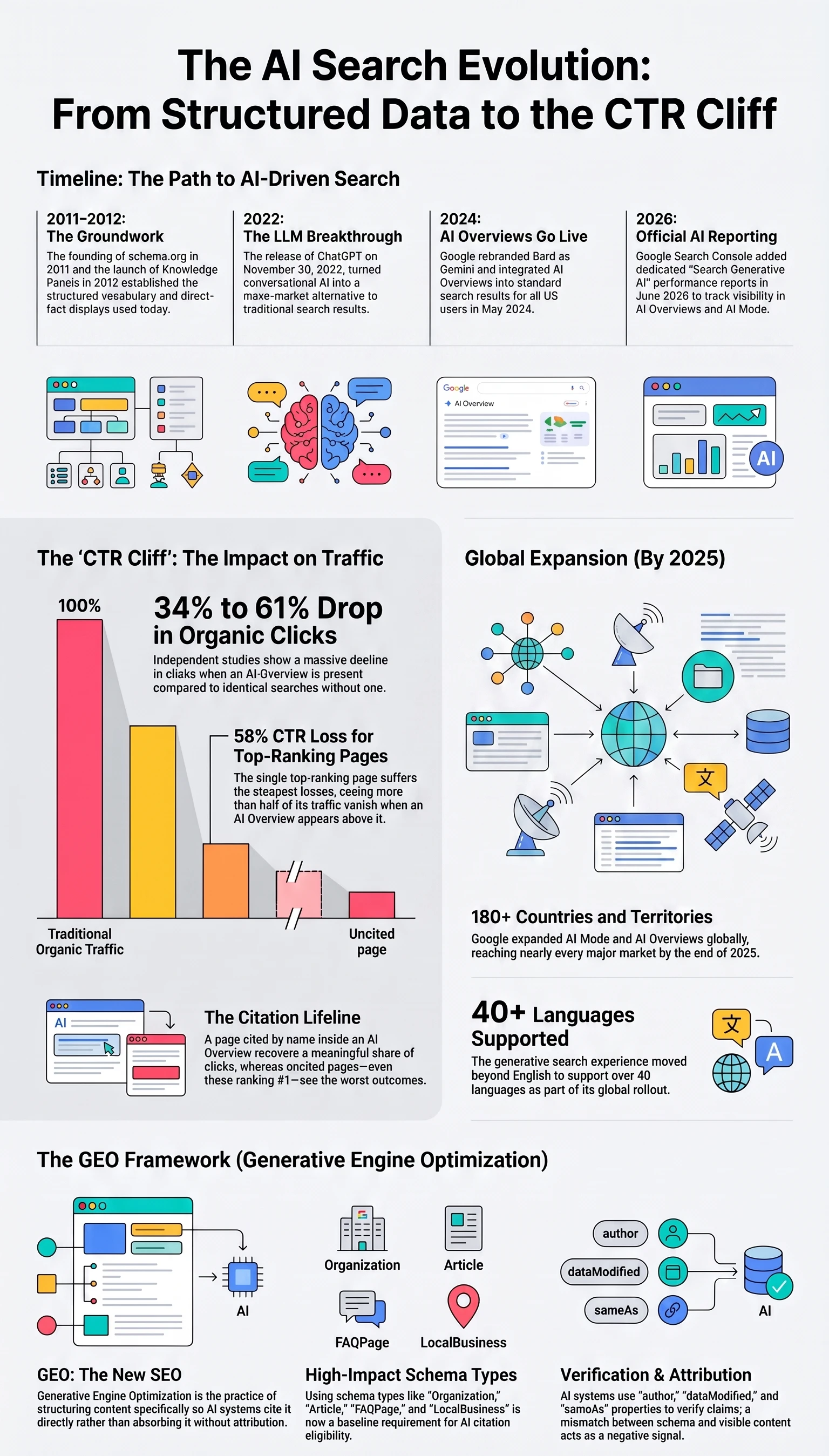
Zero-click search predates generative AI by roughly a decade. Google, Microsoft, Yahoo, and later Yandex founded schema.org in June 2011, establishing a shared vocabulary for structured data that underlies most of what follows in this guide. Google had introduced rich snippets in 2009, and Knowledge Panels followed in 2012, pulling facts directly into the results page. Featured snippets, in 2014, extended the same principle to direct-answer questions. Depending on measurement methodology, roughly a quarter of Google searches were already ending without a click before large language models entered the picture.
The LLM breakthrough (2018-2022)
OpenAI released GPT-1 in 2018 and GPT-2 in 2019, the latter withheld from full release initially over misuse concerns. GPT-3, released in 2020 at 175 billion parameters, represented a significant capability increase over prior models. None of this reached general public use in a way that changed search behavior until November 30, 2022, when OpenAI released ChatGPT, built on an upgraded GPT-3.5, as a public research preview. This is the point at which conversational AI became a mass-market alternative to a search results page.
Search engines respond (2023)
Microsoft launched Bing Chat in February 2023, built on GPT-4, rebranding it Copilot by November of that year. Google announced Bard the same month, initially built on its own LaMDA model, opening to US and UK users in March. At Google I/O in May 2023, Google introduced the Search Generative Experience (SGE), an AI-generated summary placed inside regular search results rather than a separate chat product, rolled out through the opt-in Search Labs program and reaching more than 120 countries by November.
Two developments later in 2023 had a longer-term effect than either product launch. In December, Google announced Gemini, its first natively multimodal model family, and integrated Gemini Pro into Bard within days. In November, researchers from Princeton, Georgia Tech, the Allen Institute for AI, and IIT Delhi published the paper that coined the term generative engine optimization, formalizing a discipline that had no established name a year earlier.
AI Overviews go live (2024)
Google rebranded Bard as Gemini in February 2024. In May, at I/O 2024, SGE exited Search Labs entirely: rebranded AI Overviews, it began rolling out to all US users on May 14, 2024, without an opt-in requirement. Expansion followed quickly, reaching the UK, India, Japan, Indonesia, Mexico, and Brazil by August, and more than 100 countries by late October.
AI Mode and going global (2025)
AI Mode launched March 5, 2025, as a Search Labs experiment limited to Google One AI Premium subscribers in the US, running on a custom Gemini 2.0 build. At I/O 2025 in May, Google removed the opt-in requirement for US users and upgraded the underlying model to Gemini 2.5. Expansion continued through the year to India, the UK, Malaysia, and further markets, reaching 180 countries and territories by year's end; AI Overviews itself passed 200 countries and 40-plus languages around the same period.
2025 also produced the first significant legal pushback. Chegg filed an antitrust lawsuit in February, citing direct traffic and revenue damage from AI Overviews. Penske Media (Rolling Stone, Billboard, Variety) became the first major US publisher to sue Google on similar grounds. European publishers filed a formal antitrust complaint with the EU over the same underlying issue, that AI Overviews summarize articles without payment or permission. Chartbeat, tracking referral data across thousands of news sites, recorded roughly a one-third decline in Google search referrals to news publishers across the year.
2026 developments
At I/O 2026 on May 19, Google merged AI Overviews and AI Mode into a single experience powered by Gemini 3.5 Flash, which became the default AI Mode model globally the same day. Google said at the event that AI Mode had passed one billion monthly users roughly a year after launch, with query volume more than doubling every quarter since. Third-party tracking (not an official Google figure) puts AI Overviews' presence at approximately 48% of all Google searches as of March 2026, up from roughly 31% in early 2025. Presence estimates vary widely by methodology; SparkToro's panel-based measurement of US searches over January to April 2026 put AI Overviews on just over 20% of searches, and measured AI Mode at 0.34% of all searches over the same period.
On May 27, 2026, Google announced three changes aimed at making source links inside AI Overviews and AI Mode more prominent. Preferred Sources, previously limited to Top Stories, was extended into both AI surfaces, labeling results from publishers a user has explicitly chosen; Google said users are twice as likely to click a Preferred Source and that more than 345,000 unique sources had been selected. A prominent link carousel began appearing on developing-topic queries. A "Highly Cited" badge was extended to more article links, marking pieces that other articles frequently cite. The carousel reached full availability in the United States on mobile on July 17, 2026, surfacing Top Stories directly inside AI Overviews.
The same day, Google SVP Nick Fox stated publicly that Google is "sending billions of clicks to websites every week through AI features in Search alone." Google has not released the underlying click data or a baseline to compare it against, and Search Console has no way to isolate it. A Pew Research Center analysis of browsing data from 900 US adults, published around the same period, found the opposite direction: users clicked a traditional search result on 8% of visits when an AI summary appeared, versus 15% when it did not, and clicked a link cited inside the summary itself on just 1% of visits. Pew also found 26% of visits with an AI summary ended the browsing session entirely, compared with 16% without one.
The legal questions raised in 2025 produced mixed outcomes in 2026. A US court dismissed at least one major publisher antitrust case against Google in early 2026, rejecting monopoly-power claims. In Munich, a German court ruled the opposite direction in May 2026, stripping AI Overviews of the safe-harbor protection that has historically shielded search engines from defamation liability, on the basis that an AI-generated answer making an independent, substantive claim constitutes Google's own speech rather than third-party content Google is merely surfacing. Google confirmed it would appeal.
Penske Media's own antitrust suit against Google, filed in September 2025 over AI Overviews' use of its journalism, remained active through the summer. At an August 25, 2026 hearing on Google's motion to dismiss, Judge Amit Mehta, the same judge who found Google held an illegal monopoly in general search in the 2024 US v. Google ruling, pushed back on Google's characterization of AI Overviews as a "product improvement," calling the arrangement "seems really unfair" and noting that product improvements are "not immune from antitrust scrutiny." Mehta had not ruled on the motion as of this writing.
On June 3, 2026, Google Search Console added a dedicated Search Generative AI performance report, giving site owners visibility into how often their pages appear inside AI Overviews, AI Mode, and Discover's AI features, along with a toggle to opt a site out entirely. Further detail on this report is available in this site's coverage of the Search Console AI report.
On August 27, 2026, Google confirmed it had begun dynamically expanding AI Overviews into a full, AI Mode-style response for some queries, removing the "Show more" button entirely and pushing standard search results further down the page. If a visitor has already started scrolling past the Overview, Google cancels the expansion so they don't lose their place. A Google spokesperson said the change applies "for topics where our systems determine it's most useful for people," and that testing showed it leads people to "engage deeper in follow-up exploration."
Impact on organic traffic
Independent measurement of organic click-through rate (CTR) impact varies by methodology, but converges on a consistent direction: CTR drops somewhere between 34% and 61% on a search where an AI Overview appears, compared to an identical search without one. A randomized field experiment, generally considered stronger evidence than correlational analysis, measured a 38% drop in organic clicks on queries where an AI Overview was artificially triggered. A separate analysis of 300,000 keywords found the single top-ranking page's CTR fell 58% when an AI Overview appeared above it, a figure consistent with the traffic-decline numbers cited in publisher antitrust filings during the same period.
The zero-click baseline has moved as well. A SparkToro study published June 9, 2026, using Similarweb panel data for US Google searches from January through April 2026, found 68.01% of searches ended without a click to the open web, up from 60.45% in 2024. Click-generating searches fell 9.51 percentage points over that span, a 22.9% decline, while searches that led only to another Google search rose 7.2 points. The study also measured a CTR drop of close to 60% on searches where an AI Overview appeared, consistent with the upper end of the range above.
A page's outcome under this system falls into one of three states. Absent from an AI Overview's source index entirely, a page gets nothing: total traffic starvation, the worst outcome measured. Present in the underlying answer but not named, a page still absorbs steep losses, its information used to generate the response without attribution. Named inside the AI Overview, a page recovers a meaningful share of the clicks the Overview otherwise absorbs, the one state where the recovery described above actually applies. Rank alone does not determine which state a page lands in; a page ranking first with no citation loses more than a lower-ranked page that gets named.
Industry response
Generative engine optimization (GEO) describes the practice of structuring content so AI systems cite it directly rather than absorbing it into an answer without attribution. It functions as an addition to standard SEO rather than a replacement for it; content that ranks well for conventional reasons, relevance, clarity, and demonstrated trustworthiness, remains the foundation GEO builds on.
Structured data's role has grown accordingly. Schema.org existed for over a decade primarily to enable rich results (star ratings, event dates, recipe times). In the current environment it functions closer to a baseline requirement for AI citation eligibility. The schema types most consistently associated with AI citation are Organization, Article, FAQPage, Product, and LocalBusiness, with properties such as author, dateModified, and sameAs links to sources like Wikidata providing the disambiguating detail AI systems use to verify and attribute a claim. A mismatch between what a schema block asserts and what a page visibly displays is treated as a negative signal rather than a shortcut.
Changelog
September 1, 2026 — Added the August 25, 2026 Penske Media v. Google hearing (Judge Mehta's "seems really unfair" comments on Google's AI Overviews product-improvement defense), per Search Engine Journal. Added the August 27, 2026 AI Overviews dynamic full-page expansion into an AI Mode-style response, per Search Engine Land and Google's on-record statement to press.
July 28, 2026 — Added the May 19, 2026 I/O announcements (AI Mode passing one billion monthly users, Gemini 3.5 Flash as global default), the May 27, 2026 Preferred Sources, link carousel and Highly Cited changes, the July 17, 2026 Top Stories rollout inside AI Overviews and Nick Fox's "billions of clicks per week" statement, per Google's Search blog and Search Engine Land. Added Pew Research Center's counter-data on the Nick Fox claim (8% vs. 15% click rates with/without an AI summary present). Added SparkToro's June 9, 2026 zero-click study (68.01% of US searches, up from 60.45% in 2024) to the organic traffic section.
July 28, 2026 — Guide published, covering schema.org's 2011 founding through the June 2026 Search Console AI report and the May 2026 Munich defamation ruling.
More Resources
Google Algorithm Update History: A Living Timeline (2011-2026)
A running record of Google's major core algorithm updates from Panda through the 2026 core updates, with dates, what changed, and official sourcing.
ResourcePhilippine Digital Compliance Guide for Business Websites
What Philippine law actually requires of a business website: data privacy, e-commerce disclosure, and business registration, in plain language.
ResourceDigital Marketing & SEO Glossary | Audrim Resources
Plain, precise definitions of the SEO, web design, and digital marketing terms Philippine business owners run into most. Updated as terminology changes.